Integrating independent artificial intelligence systems to improve output quality, complex problem-solving capabilities, and automation reliability.
When a Single AI Agent Is No Longer Enough
The evolution of artificial intelligence agents is transforming how we manage IT infrastructure, develop software, analyze information, and automate daily operations.
Platforms such as OpenClaw and Hermes make it possible to build AI assistants equipped with specialized skills, persistent memory, operational tools, and the ability to interact directly with systems and applications.
However, moving from experimentation to continuous production use exposes several limitations:
- Agents can lose operational context.
- Directives may be interpreted inconsistently.
- Updates can break previously working features.
- Some technical problems exceed the capabilities of the underlying model.
- Agents can get stuck in repetitive loops of failed attempts.
- A solution reported as working may not actually function in practice.
- A single configuration error can disrupt entire automation chains.
From these observations comes an integration project combining OpenClaw, Hermes, and Antigravity CLI, aimed at building a more autonomous, controllable, and resilient AI ecosystem.
Three AI Systems, Three Complementary Roles
The core idea behind the project is not to decide which artificial intelligence is “better” than the others, but to leverage the strengths of each system by assigning it a clear role.
OpenClaw: Orchestration and Specialization
OpenClaw serves as the multi-agent system dedicated to operational management. Through specialized agents and subagents, it can handle:
- Systems administration.
- Infrastructure monitoring.
- Application and service management.
- Automations.
- Information analysis.
- Document management.
- Financial and organizational tasks.
- Scheduled task execution.
Each agent has its own specific skills, directives, tools, and domain knowledge.
Hermes: Operational Autonomy and Knowledge
Hermes provides a second, independent AI environment usable for operational tasks, analysis, development, research, and knowledge management. Having two distinct systems allows responsibilities to be distributed, results to be compared, and dependence on a single platform to be reduced.
Hermes can also contribute to managing a shared knowledge base where technical documentation, standard operating procedures, configurations, and solutions to recurring issues are preserved.
Antigravity: Specialist Development, Review, and Repair
Antigravity CLI, invoked via the agy command, takes on the role of an external specialist engine. Its purpose is to step in when OpenClaw or Hermes encounter challenges they cannot resolve on their own.
It can be used to:
- Develop new features.
- Analyze complex source code.
- Diagnose malfunctions.
- Repair scripts and automations.
- Perform refactoring.
- Review configurations.
- Identify regressions.
- Write and verify tests.
- Maintain components of the multi-agent systems themselves.
In this architecture, Antigravity does not replace the other assistants: it extends their capabilities.
System Architecture
The design deploys OpenClaw and Hermes on two separate machines. Antigravity CLI is installed on the machine hosting OpenClaw, and is also made accessible to Hermes over a controlled SSH connection.
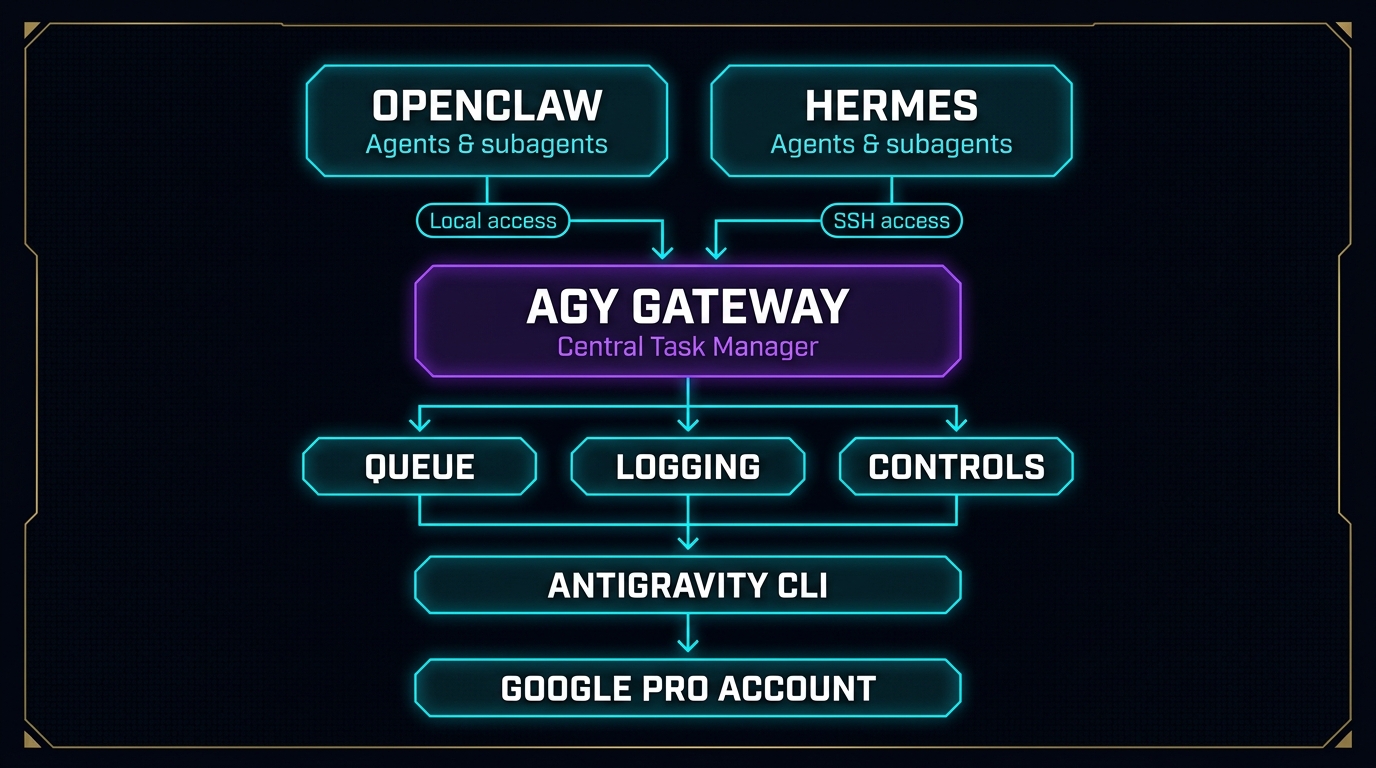
At the center of the architecture sits AGY Gateway, a dedicated component responsible for receiving, managing, and monitoring requests. It is not another language model, but an orchestration layer that enables both AI systems to use Antigravity as a shared operational resource.
Delegated tasks directly use the Google authentication configured in Antigravity, within the features and quotas allowed by the subscription. Meanwhile, OpenClaw and Hermes continue to rely on their standard LLM providers for everyday tasks.
Not Just a Model Fallback
Many AI systems already include fallback mechanisms: when one model is unavailable, the request is routed to another model. This implementation takes a fundamentally different approach. Rather than simply swapping the model that generates a text reply, an entire operational task is delegated to an independent specialist environment.
| Traditional LLM Fallback | Operational Delegation to Antigravity |
|---|---|
| Model substitution | Handing off an entire task |
| Generating a response | Analysis, implementation, and testing |
| Primarily conversational context | Technical context and workspace |
| Generally availability-oriented | Problem-solving oriented |
| Verification often left to the user | Independent verification by agents |
| Limited to the caller’s tools | Controlled access to specialist tools |
The difference is substantial: Antigravity becomes an external technical collaborator, not merely a backup model.
How Automatic Delegation Works
Suppose an OpenClaw agent needs to repair an automation that stopped working after an update. The agent analyzes the issue, consults the documentation, and attempts an initial fix. If the problem persists, it makes a second reasoned attempt. Once it recognizes that it cannot resolve the issue on its own, it triggers the delegation procedure to Antigravity.
The workflow consists of:
- Gathering technical context.
- Identifying errors.
- Recording attempts already made.
- Preparing a controlled workspace.
- Creating a backup or checkpoint.
- Submitting the request to AGY Gateway.
- Processing via Antigravity.
- Retrieving the resulting changes.
- Independently verifying the outcome.
- Running tests.
- Applying changes permanently or rolling back.
- Updating documentation.
The crucial element is the agent’s ability to recognize when it needs to change strategy. Repeating the same attempts with the same model and approach rarely leads to the best outcome.
What Becomes Possible
This integration expands the operational capabilities of each individual system and unlocks more sophisticated workflows.
Advanced Software Development
Agents can delegate complex implementations, repository analysis, bug fixing, refactoring, and test creation. This makes it possible to tackle projects that might exceed the operational capabilities of the models normally used by the agents.
Infrastructure Maintenance
The system can be applied to managing:
- Linux servers.
- Docker containers.
- Proxmox.
- OPNsense firewalls.
- Monitoring systems such as Zabbix and Graylog.
- Web applications.
- Databases.
- Backup systems.
- Node-RED automations.
- Home Assistant.
- API and MCP integrations.
When an agent encounters a particularly complex configuration, it can request specialist analysis without necessarily halting the entire workflow.
Self-Repair of the AI Agents Themselves
One of the most compelling applications is maintaining the AI systems themselves. Antigravity can help diagnose and fix:
- Broken skills.
- Misconfigurations.
- Missing directives.
- Authorization issues.
- Stuck scheduled tasks.
- Unavailable tools.
- Incompatibilities introduced by updates.
- Configuration persistence issues.
The AI system thus becomes potentially capable of contributing to its own maintenance through an external, independent component.
Cross-Review
Another option is to use Antigravity not only when something breaks, but also to verify work completed by other agents. One agent develops a solution, Antigravity reviews it, and another component verifies the tests. This approach mirrors, at least in part, the dynamics of an engineering team composed of developers, reviewers, and systems administrators.
Improving Output Quality
Using multiple AI systems does not automatically guarantee better results. The real improvement comes from separation of responsibilities. The entity that produces a solution should not necessarily be the only one tasked with validating it.
The operational pipeline becomes:
Analysis → Implementation → Independent Review → Testing → Validation
A review performed by a different system can catch errors the first model missed. Even so, validation must always rely on concrete evidence:
- Automated tests.
- Syntax checks.
- Diff comparisons.
- Log verification.
- Service status checks.
- Functional tests.
- Authorization checks.
A convincing answer produced by an AI is not proof that the job was done correctly. Quality must be measured against real-world outcomes.
Resilience: Building Systems That Withstand Failures
Resilience is one of the primary goals of the project. A resilient system is not one that never fails, but one capable of detecting issues, containing their impact, and restoring operations.
Model Resilience
OpenClaw and Hermes retain their respective LLM providers, while Antigravity operates in a separate execution environment. This reduces reliance on any single model and enables different approaches to problem-solving.
Application Resilience
AGY Gateway is designed as a service independent of the OpenClaw process. If OpenClaw stops working, Hermes can still use Antigravity as long as the host running AGY remains operational. An external administrator can also invoke the gateway to carry out repair interventions.
Operational Resilience
A persistent queue preserves request state, recovers results after a disconnection, and identifies interrupted jobs. Backups, checkpoints, and rollback procedures allow recovery from unsuccessful changes.
Knowledge Resilience
Procedures, skills, and configurations are stored in persistent, documented structures. The knowledge base—integrated with tools such as MkDocs, Zensical, and Gitea—maintains a history of implementations and adopted solutions. Operational knowledge is never trapped solely inside an AI assistant’s conversational memory.
Resilience and Current Limitations
This architecture is not yet a full high-availability solution. Antigravity resides on a single machine, which remains a single point of failure. If the entire host becomes unavailable, AGY Gateway will also be unreachable.
A future evolution could introduce a dedicated machine or a recovery setup on a second host, subject to the service’s authentication mechanisms and terms of use.
From Automation to Autonomous Maintenance
Another piece of the project is integration with an automated daily audit. OpenClaw’s Sysadmin agent periodically checks:
- Service availability.
- Configuration integrity.
- Presence of required skills.
- Persistence of directives.
- Health of interconnections.
- Authorization status.
- Recurring errors.
- Stuck tasks.
- Post-update compatibility.
- Availability of AGY Gateway.
When it detects a reversible, pre-authorized issue, it can attempt a fix. If it fails, it can delegate the intervention to Antigravity. The administrator receives a Telegram notification only when a significant fix is applied, a persistent problem occurs, or human intervention is required. This cuts down alert fatigue and focuses attention on genuinely important events.
The goal is not to eliminate the human administrator, but to reduce the time spent on repetitive maintenance.
Centralized Activity Control
Increasing agent autonomy without simultaneously increasing oversight would be a mistake. For this reason, AGY Gateway provides centralized job management. A dedicated dashboard makes it possible to monitor:
- Requesting system.
- Responsible agent.
- Running tasks.
- Queued tasks.
- Completed jobs.
- Failed jobs.
- Task duration.
- Model used, when detectable.
- Modified files.
- Tests executed.
- Errors encountered.
- Repair interventions.
- Authentication status.
Centralization also enables priority management. An urgent repair can take precedence over routine documentation or development work. Every job is assigned a unique ID, making it possible to reconstruct the complete history of interventions.
Security and Authorizations
Integrating AI agents equipped with operational tools carries significant responsibility. An artificial intelligence capable of modifying code, restarting services, and altering configurations should never operate without boundaries.
The project distinguishes three operational modes:
| Mode | Function |
|---|---|
Read Only |
Analysis and diagnostics without modifications |
Patch Only |
Generating changes for review prior to application |
Controlled Write |
Direct modifications within authorized environments |
These modes must be enforced by real technical controls, not merely by text instructions given to the agents. Additional safeguards include:
- Dedicated, restricted SSH access.
- Request validation.
- Isolated workspaces.
- Credential protection.
- Redaction of sensitive data in logs.
- Allowed-path enforcement.
- Backups before critical interventions.
- Least-privilege restrictions.
- Prohibition of unauthorized privilege escalation.
- Rollback procedures.
Protection against prompt injection is also essential: malicious instructions embedded in documents, web pages, logs, or source files that could attempt to hijack agent behavior. Analyzed content must always be treated as data, never as new operational authorizations.
Special care must also be paid to data transmitted to external AI services, avoiding unnecessary exposure of credentials, confidential information, or personal data.
Cost and Resource Optimization
Not every task requires a frontier-class AI model. Systematically using expensive or quota-constrained models for routine administrative operations would be inefficient. The architecture therefore adopts a tiered strategy:
- Local or low-cost models for routine tasks.
- Higher-capability models for complex reasoning.
- Antigravity for specialist implementation and repair.
- Traditional scripts for deterministic operations.
- Scheduled automations for repetitive checks.
Using the already-configured Google Pro account allows leveraging the features included in the subscription, within the quotas and terms of use actually available. The gateway must never automatically fall back to pay-per-use APIs without explicit authorization.
The centralized queue also helps prevent duplicate jobs, unnecessary concurrent requests, and unproductive retry loops. Actual cost savings will need to be measured over time: greater autonomy does not automatically guarantee lower costs.
Benefits of the Implementation
| Advantage | Expected Benefit |
|---|---|
| Greater autonomy | Reduced need for routine manual interventions |
| Specialization | Using the most appropriate tool for each problem |
| Independent review | Ability to catch additional errors |
| Resilience | Stronger recovery from failures |
| Maintainability | Documented, repeatable procedures |
| Centralized control | Full traceability of operations |
| Resource optimization | Fewer wasted or redundant runs |
| Shared capabilities | Access to the specialist engine from multiple systems |
| Knowledge continuity | Preservation of procedures over time |
| Proactive maintenance | Early detection of certain malfunctions |
| Scalability | Ability to integrate additional platforms |
| Reduced lock-in | Less dependence on a single AI model |
Drawbacks and Challenges
An architecture of this kind also introduces new challenges that must not be underestimated.
| Challenge | Possible Mitigation |
|---|---|
| Higher infrastructure complexity | Modular, well-documented components |
| Dependency on the AGY host | Backups and disaster recovery procedures |
| Shared quotas across multiple agents | Queueing and priority management |
| Added latency | Delegating only when necessary |
| Risk of faulty changes | Testing, checkpoints, and rollback |
| Authentication issues | Health checks and targeted alerts |
| Post-update incompatibilities | Periodic audits and regression tests |
| Security risks | Isolation and controlled permissions |
| Conflicts between agents | Workspace separation and coordination |
| Dependency on external services | Retaining independent providers and tools |
| Difficulty evaluating quality | Objective metrics and independent verification |
| Higher maintenance overhead | Automated checks and documentation |
Another risk is over-reliance on AI outputs. Two or three artificial intelligences can still arrive at the same wrong conclusion. Cross-review is valuable, but it does not replace objective testing.
Before and After: What Changes in Practice
| Aspect | Traditional Setup | Integrated Ecosystem |
|---|---|---|
| Unresolved issue | Human intervention | Possible specialist delegation |
| Post-update error | Manual diagnosis | Automated audit and potential repair |
| Complex development | Bounded by the agent’s limits | Cross-system collaboration |
| Code verification | Often handled by the same model | Independent review |
| Task management | Distributed | Centralized specialist queue |
| Technical knowledge | Isolated memories | Shared documentation |
| Notifications | Potentially noisy | Focused on meaningful events |
| Recovery | Often manual | Structured rollback procedures |
| Cost control | Dependent on individual agents | Shared delegation policies |
How to Measure Real Improvements
Evaluating the effectiveness of this implementation requires more than simply counting completed tasks. Measurable indicators must be tracked over time. Key metrics include:
- Percentage of issues resolved without human intervention.
- Percentage of AGY delegations completed successfully.
- Mean time to resolution (MTTR).
- Mean time to detection (MTTD).
- Number of manual interventions required.
- Number of regressions introduced.
- Test pass rate.
- Rollback frequency.
- Number of recurring errors.
- Duplicate jobs avoided.
- Service availability.
- Effective cost per completed task.
- Administrator time saved.
These indicators will show whether the added architectural complexity delivers genuine operational value. It would not be honest to claim percentage improvements before gathering sufficient data from real-world usage.
The Role of the Human Administrator
The future of AI agents does not necessarily lie in fully autonomous systems operating without oversight. A more realistic approach is controlled autonomy. Agents can handle repetitive tasks, analysis, development, and routine repairs, while the administrator retains control over strategic decisions, authorizations, and critical interventions.
The human role gradually shifts from manual execution to supervision, architecture, and infrastructure governance. Artificial intelligence does not remove the need for technical expertise: it enables that expertise to be applied more effectively.
Possible Future Evolutions
AGY Gateway can serve as a foundation for further integrations with:
- OpenCode.
- Node-RED.
- OmniRoute, for coordinating routine workloads.
- Monitoring systems.
- CI/CD platforms.
- Git repositories.
- Disaster recovery systems.
- Additional AI agents.
- Code analysis and review tools.
One possible evolution is a system capable of dynamically selecting not just the language model, but the entire operational environment best suited to each task. An agent could decide whether to run a traditional script, a local model, a remote AI service, or delegate the problem entirely to a specialist environment.
Value would no longer lie solely in the power of a single model, but in the ecosystem’s ability to coordinate diverse tools and capabilities.
Conclusions
Integrating OpenClaw, Hermes, and Antigravity represents an approach to building multi-agent AI systems centered on collaboration, resilience, and control. The goal is not merely to have more artificial intelligences available.
It is to build a system where every component can recognize its own limits, request support, verify the work of others, and contribute to maintaining the entire infrastructure. An ecosystem where agents do not simply execute tasks, but also handle unexpected failures, document solutions, and continuously refine their own procedures.
The true evolution of artificial intelligence applied to IT infrastructure may not come from a single ever-more-powerful model, but from collaboration among independent, specialized systems subject to verifiable controls.
No longer just AI agents that work, but AI agents that collaborate, verify one another, and mutually contribute to their own reliability.
Project note: the architecture described represents an integration project currently under implementation and validation. The benefits outlined are expected objectives to be verified through testing and measurement in real-world operation.